Presentation at WAC - November 19-21, 2025 in Paris
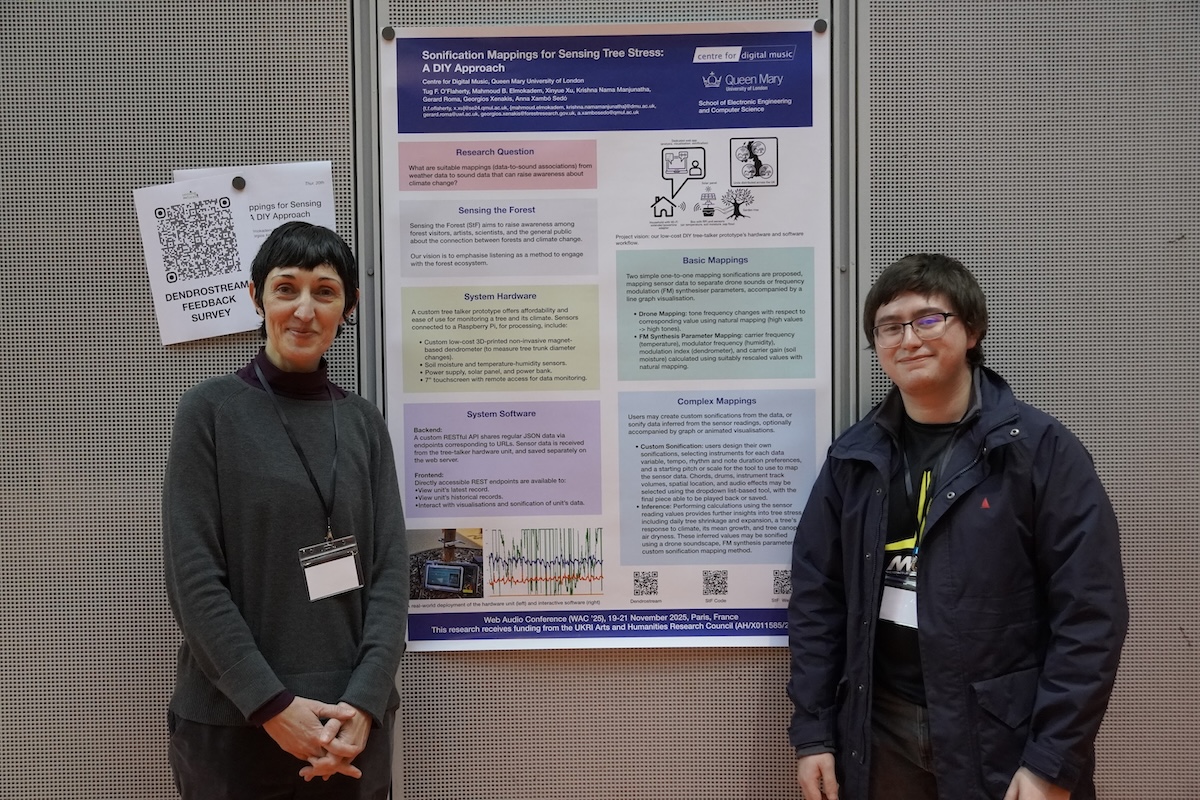
📷 Top photo: from left to right: Anna Xambó and Tug O’Flaherty with the poster. Photo Credit: Victor Paredes.
Conference Overview
From 19th to 21st November 2025, Anna Xambó and I (Tug O’Flaherty) had the privilege of presenting some of the Sensing the Forest project work at the Web Audio Conference (WAC 2025), held at IRCAM in Paris, France.
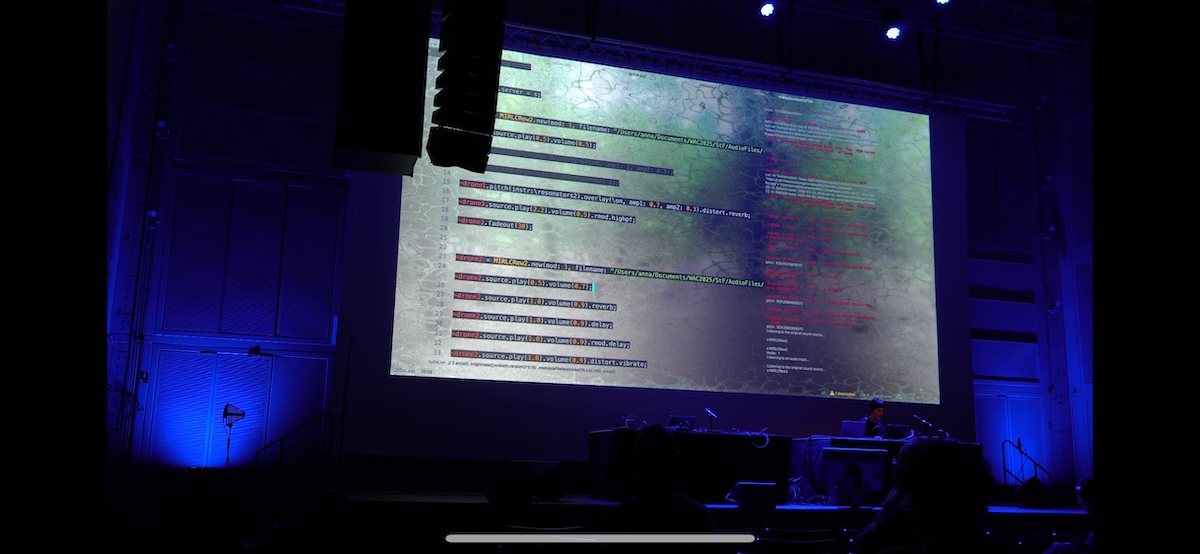
On the first day (19th November 2025), Anna chaired the first session of the conference, on Applications and Live Coding, before delivering an excellent performance in that evening’s first concert on live coding, entitled “Sensing the Alice Holt Forest”. The audience were treated to an impressive soundscape, focused around the sounds recorded from the streamers (developed by Dr Luigi Marino) located within the forest, accompanied by corresponding video footage of the streamers’ surroundings.
The second day (20th November 2025) saw Anna and I present a poster discussing our short paper, entitled “Sonification Mappings for Sensing Tree Stress: A DIY Approach” [1], at the Poster Session 2, over lunch. The poster attracted attention and interest from many attendees, prompting some interesting discussion, and providing us with the opportunity to explain more about the project, and our work.

During the final day (21st November 2025), we took part in the first Demos Session. Here, we provided greater insights into the work presented within our paper, alongside live demonstrations of the original chart.js-based sonification and visualisations, and the varied, complex mappings within the Dendrostream tool.
Feedback and Suggestions
Throughout all of our interactions and discussions with attendees, we captured any feedback and suggestions we received. We were grateful to have many suggestions of related work to investigate, including that of Hans Lindetorp’s WebAudioXML Sonification Toolkit [2], and sound artist Mileece. Comments also related to the benefits of a generalisable framework, to ensure the tool could be repurposed for different datasets or environments, and the creation of a p5.js library, to improve students’ use.
Moreover, some suggestions related to a lack of information on what a “sad tree” is, within the metaphorical happy/sad tree concept, the need to add more forest research information as appendices, and the ideal tree species to use, presented within the Dendrostream tool. In relation to the tree talker hardware units, it was suggested that a switch from using Raspberry Pi to the ESP32 platform, could assist in a reduction of unit cost, size, and power consumption.
Final Words
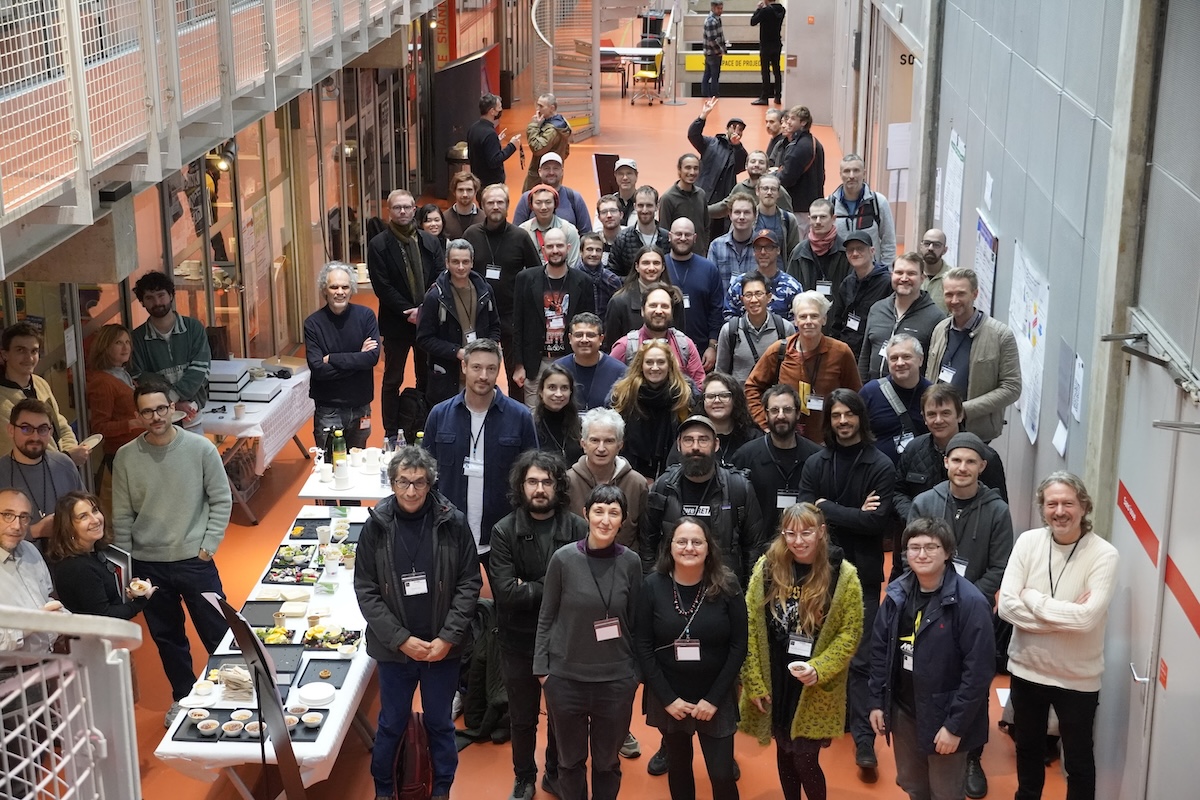
Attending the Web Audio Conference was an amazing experience, for which I am very grateful to have had the opportunity. As my first in-person conference, it was rewarding to be able to present the incredible outputs of the Sensing the Forest team, and receive such useful feedback, to assist in the developing the project further, in the future. Furthermore, seeing all the extraordinary work being accomplished in this field was inspiring, and has given me lots of interesting ideas for the future!
Further Reading
📄 The short paper can be found at: https://doi.org/10.5281/zenodo.17642479
📄 The poster can be found at: http://sensingtheforest.github.io/assets/pdf/WAC-2025.pdf
🌐 The Dendrostream tool can be found at: http://stf-sv-tool.pages.dev/
🌐 More details about Sensing the Forest can be found at: http://sensingtheforest.github.io/
🌐 More details about the conference can be found at: http://wac-2025.ircam.fr/