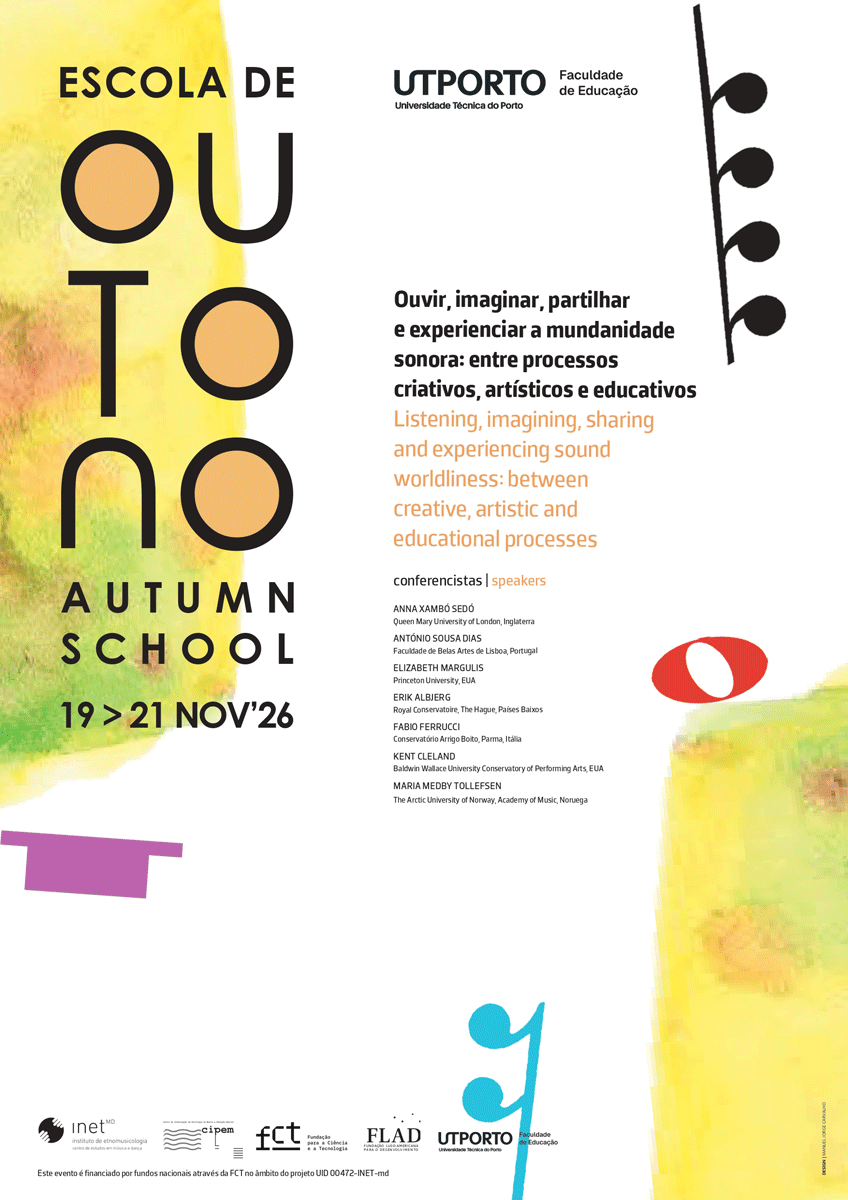
Presentation at Autumn School - November 21, 2026
I will be giving a keynote on Saturday 21 November 10:00-11:00 on “Listening, Seeing, Tinkering: Sensing the Forest through Sound Data” at the Autumn School 2026: Listening, imagining, sharing and experiencing sound worldliness: between creative, artistic and educational processes. 19-21 November 2026. Faculdade de Educação, Universidade Técnica do Porto, Porto, Portugal. Moderator: Filipe Lopes.
Abstract
How can listening, sound and music help people understand a forest and a changing climate? Sensing the Forest (sensingtheforest.github.io), funded by the UKRI Arts and Humanities Research Council (2023-2026), explores this question by presenting complex scientific data in creative and artistic ways to raise awareness among forest visitors, artists, scientists and the public about the connection between forests and climate change.
This talk presents the project and lessons learned from working in an interdisciplinary team, focusing on three strands:
- A one-year artistic intervention, on site and online, in Alice Holt Forest (UK), using live scientific data to foster acoustic ecology experiences (guided listening to natural and modified soundscapes) that encourage new ways of listening to the forest.
- A custom-built Internet of Things (IoT) prototype. The prototype measures tree stress indicators, including stem diameter, air temperature, humidity and soil moisture, and was piloted using citizen science methods with a web application for data analysis, visualisation and sonification (turning data into sound).
- Live coding as an art-science tool of enquiry: writing code in real time to create music and visuals, here used to explore place, time, memory and climate change.
The talk discusses the challenges and opportunities of the project, asking how artistic and citizen science methods can help inform and educate people about climate change. It also reflects on what this work offers to music education and practice-based research, for example sonification as a teaching tool, live coding as a performance practice, listening as a pedagogical approach, and interdisciplinary collaboration as a model for student projects. Lessons learned include how to translate data into sound without misrepresenting it, how to build a shared language across art, science and technology, and why long-term observation matters for understanding nature in depth.
Registration is free but mandatory and must be completed via the registration form, available until 17 November. For more info about the conference visit: https://www.inetmd.pt/en/events/autumn-school-2026-listening-imagining-sharing-and-experiencing-sound-worldliness-between-creative-artistic-and-educational-processes/
Acknowledgements
Thank you to Jorge Alexandre Cardoso Marques da Costa for the invitation.