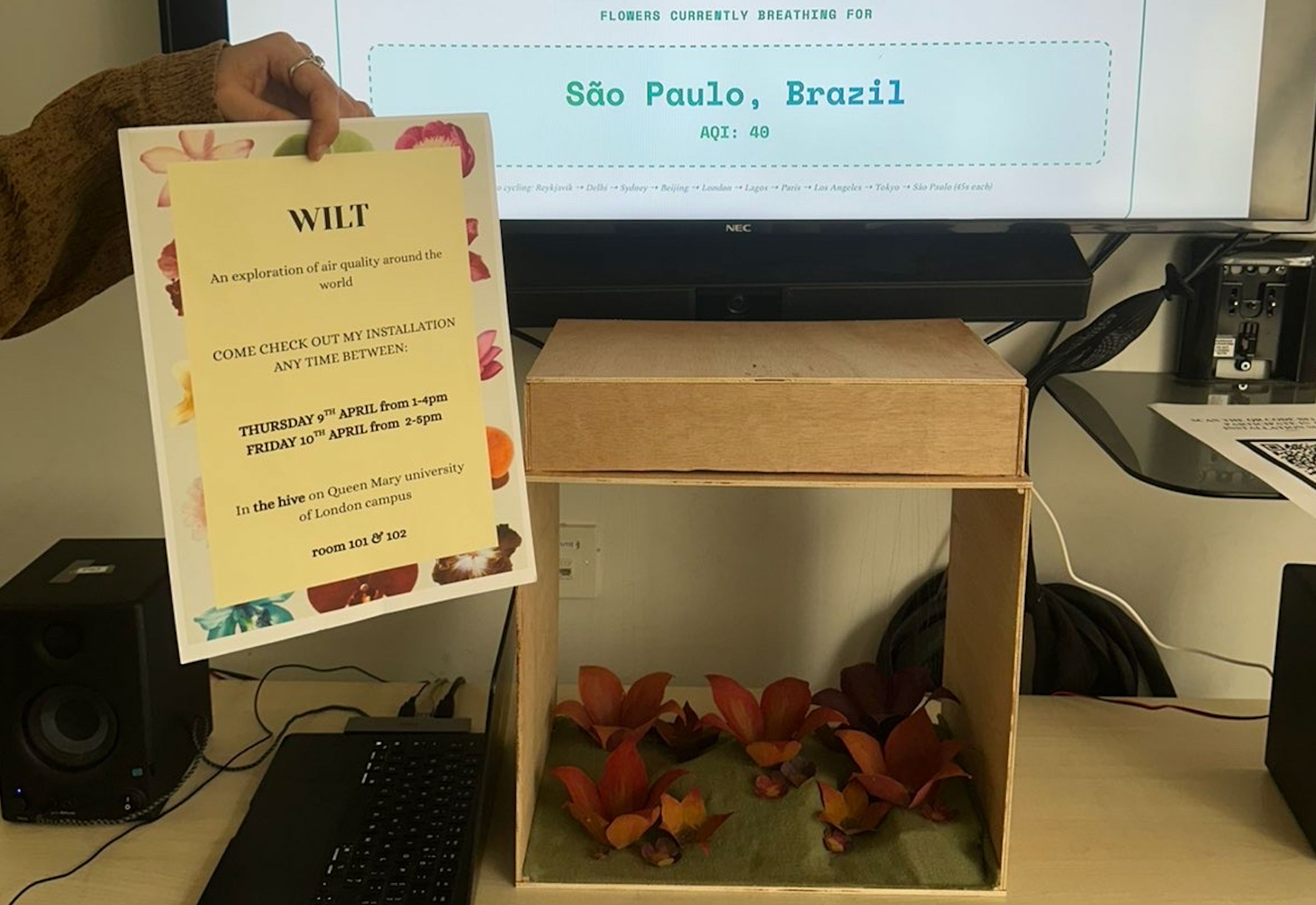
WILT – Using Solar-Powered Kinetic Art to Communicate Climate Change
Introduction
Climate change is one of the most pressing issues of our time, yet public engagement remains critically inadequate. Traditional communication methods such as: statistics, scientific reports, and news headlines, frequently fail to create the emotional resonance needed to inspire action. For my final year project at Queen Mary University of London, I set out to explore whether interactive art powered by renewable energy could bridge this gap in a way that data alone never could.
The result was Wilt: a solar-powered kinetic art installation in which five servo-driven paper flowers breathe freely or struggle depending on live air quality data fetched in real time from cities around the world. The piece cycles through ten globally selected cities every 45 seconds, from Reykjavik in Iceland, one of the cleanest cities on earth, to Delhi and Beijing at the other extreme. As the data changes, so does the movement of the flowers. Good air quality produces full, open blooms moving freely. Poor air quality produces slow, laboured, restricted movement.
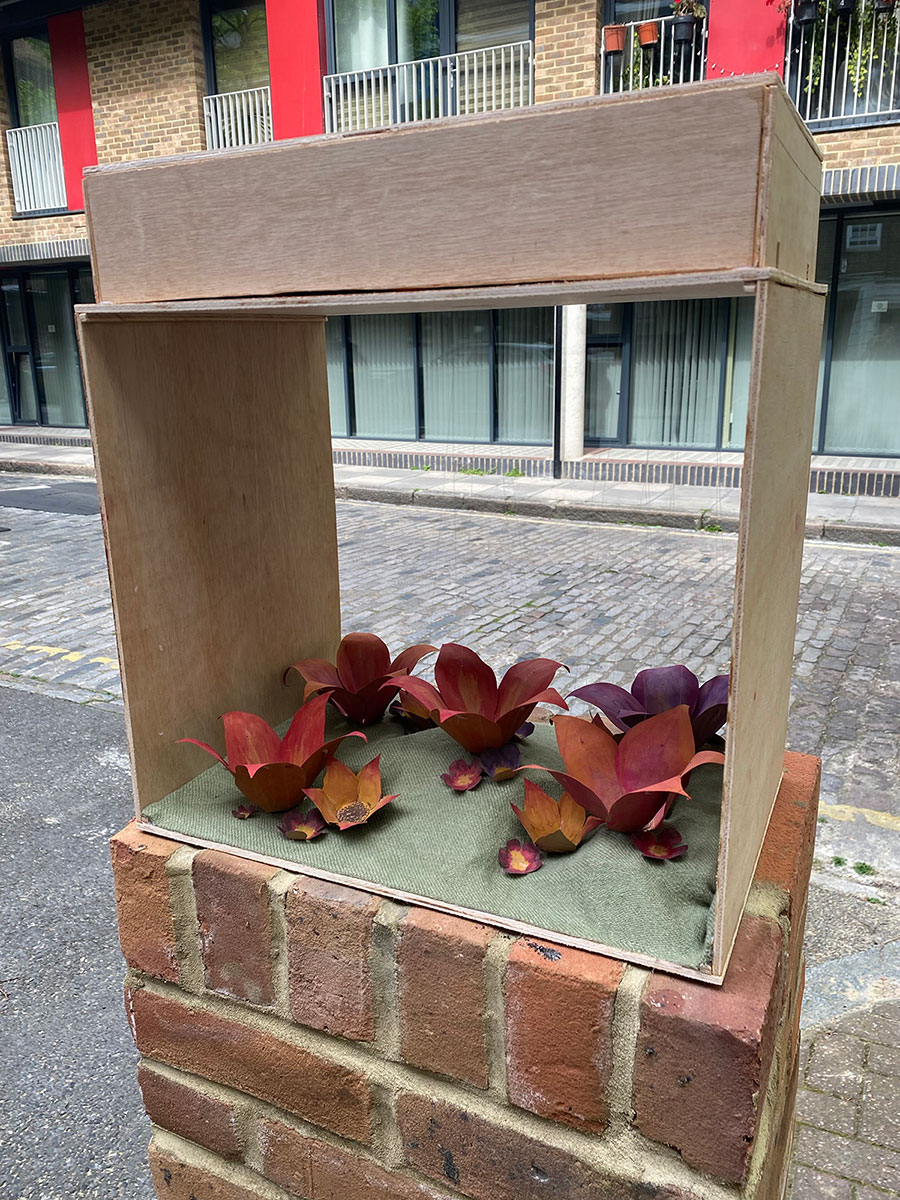
Development
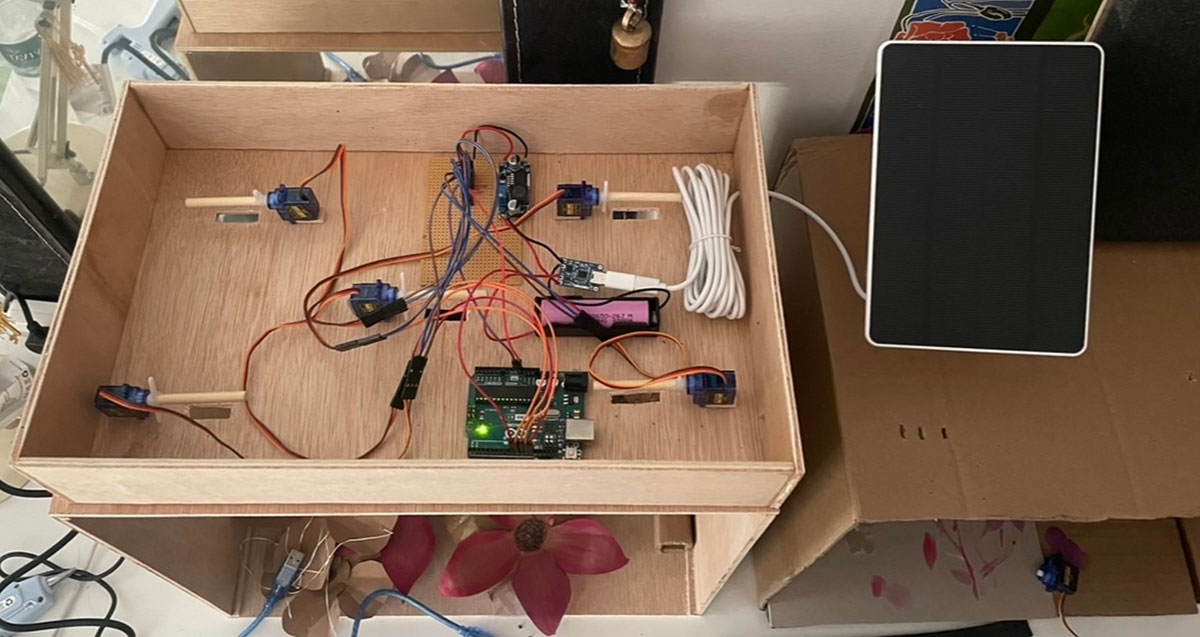
The technical system behind the installation brings together several layers of software and hardware working as one. An Arduino Uno microcontroller manages five SG90 servo motors through a synchronised breathing function, with movement speed and range calibrated precisely to each air quality state. A Python control script handles all the intelligence, making live API calls to the OpenWeatherMap Air Pollution API, converting the data, and transmitting commands to the Arduino over USB serial. The whole system runs on renewable energy: a 5W solar panel charges an 18650 lithium-ion battery through a TP4056 charging module, stepped up to stable 5V by an XL6009 boost converter. The solar infrastructure was deliberately left visible as the power system is part of the message, not infrastructure to be hidden.
A companion website extended the installation’s reach beyond the physical display, featuring a live city monitor kept in sync with the flowers, an interactive global air quality map, and educational pages on AQI and solar power.
Evaluation
What distinguishes Wilt from much of the climate art that preceded it is that it was systematically evaluated. The installation was exhibited at Queen Mary University of London, where participants completed paired pre and post surveys and took part in semi-structured interviews. The findings were significant. Climate concern rose from 3.84 to 4.48 out of 5. Motivation to act increased from 3.56 to 4.35. Most strikingly, the proportion of participants who considered interactive art installations an effective method of climate communication rose from 20% before the exhibition to 96% after it. The dominant emotional responses were curiosity, hope, and inspiration, not fear or helplessness.
Conclusion
Wilt contributes something that has been largely absent from the field of climate communication: connection. And now a methodological template now exists for how data-responsive kinetic art, renewable energy infrastructure, and rigorous evaluation can work together. One that future artists, researchers, and climate communicators can take, replicate, and build upon.
Acknowledgements
I would like to express my sincere gratitude to my supervisor Dr Anna Xambó Sedó, for her unwavering guidance, support, and feedback throughout this project. I would also like to thank Kok Ho Huen, the electronics lab manager at Queen Mary University of London, and David Wilkinson, the electronic lab technician, for their helpful knowledge and advice, and for providing access to the resources that made the physical build possible. Finally, I would like to thank my brother, Cosmo Rumpal, for composing the original music tracks that brought the installation to life. His contribution added a dominion to the project I could not have achieved alone.